What We Can Learn from Bald Eagles and Their Recovery
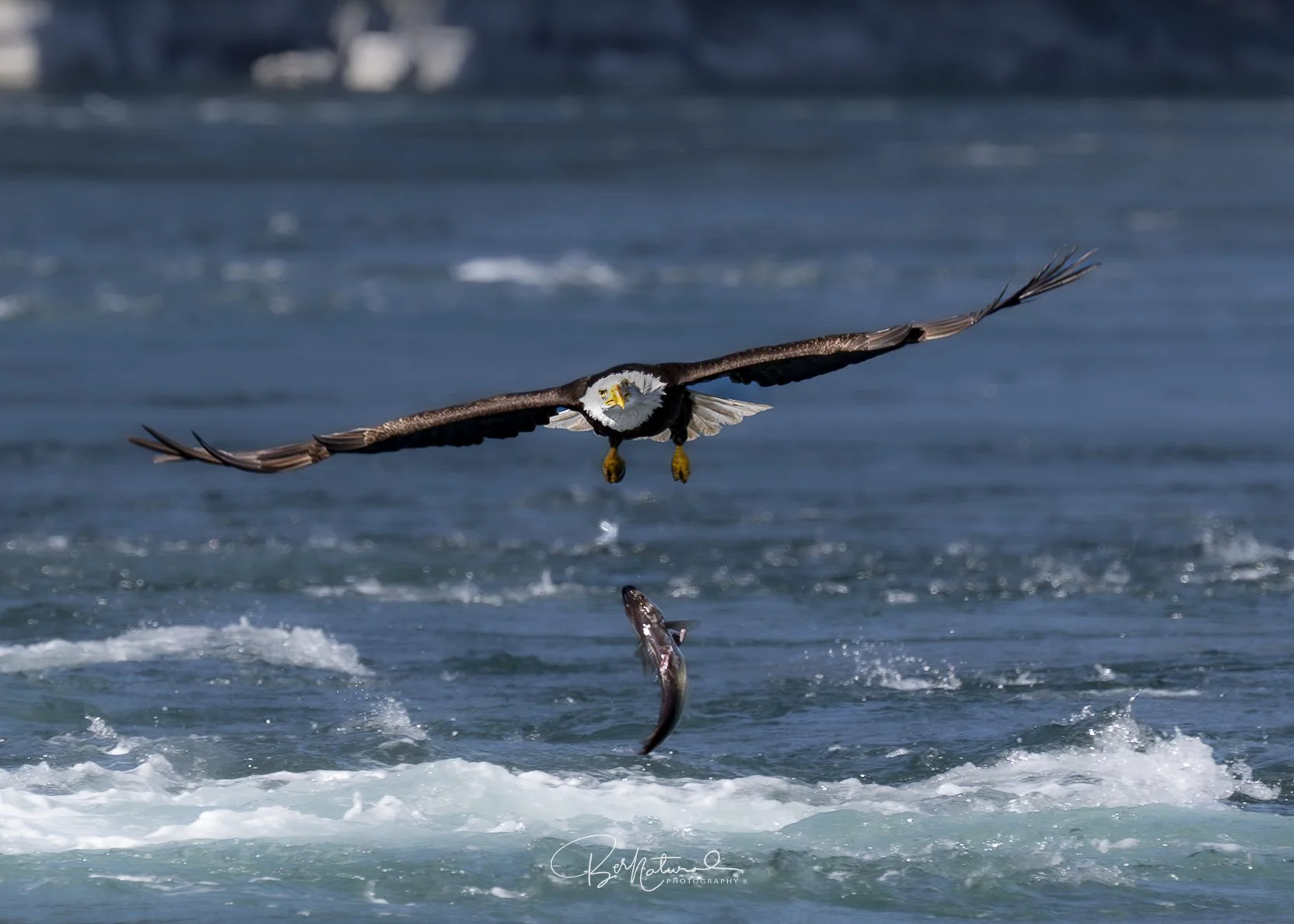
Drop what no longer works for us. Nikon Z8, 100-400mm @400mm f7.1/1250. Photo by Author
The Bird We Almost Chose to Lose
I got to spend a good amount of time with the bald eagles up by Yucalta Rapids in BC recently. So far, I’m loving almost all my photos. That’s quite a few when you fill up a card each day for almost 20 days.
This one definitely got me. Not my favorite from a technical perspective, at S/1250 on these white waters, it’s a bit jittery, some of the whites are washed out. And still, I LOVE to go back to that moment. That look in his eyes.
A bald eagle, wings fully spread, talons empty, pulling away from a fish he just had to let go, too heavy to carry. The fish hangs in the air below, on his way back to the water. For a fraction of a second, the two are suspended together above the rapids, with the eagle looking directly at me, with a wonderful expression in its eyes. I relive the moment and how it all unfolded each time I look at this photo.
What I keep coming back to is not the image itself but the fact that it exists at all after all that this species has been through.
A population in freefall
In the early 1800s, bald eagles were so numerous along North American coastlines and river systems that they were considered a nuisance. Fishermen lobbied for their removal. In 1917, the Alaska Territorial Legislature imposed a bounty, responding to claims by the salmon industry and fox farmers that eagles were competing with their livelihoods. Those claims were later largely discredited. The bounty ran for 36 years and resulted in the confirmed killing of more than 120,000 eagles. No doubt the actual number is higher, since many were killed without a bounty claim ever filed. The program ended in 1953.
In the contiguous United States, nesting populations already under pressure from habitat loss and bounties faced a new threat after World War II, when DDT entered widespread use in agriculture. DDT didn't kill eagles directly. It moved up the food chain, concentrating in fish, then in the birds that ate the fish. At sufficient concentrations, it interfered with calcium metabolism, causing eagles to produce eggs with shells too thin to survive incubation. Breeding pairs sat on their own eggs and crushed them.
By 1963, the US Fish and Wildlife Service counted 417 nesting pairs in the lower 48 states. It didn’t even qualify to report as a decline, but as being nearly wiped out from the continent. The only continent they are found.
What turned it around
DDT was banned in the United States in 1972, a decision driven in large part by Rachel Carson's 1962 book Silent Spring, which connected pesticide use to the collapse of bird populations. The chemical industry contested the ban for years. Bald eagles had received some federal protection in 1967 under the Endangered Species Preservation Act, but that listing applied only to eagles south of the 40th parallel. Full endangered status across all 48 contiguous states didn't come until 1978, five years after the Endangered Species Act passed. Breeding programs, reintroduction efforts, and nest-site protection continued through the 1980s, gradually rebuilding populations in regions where eagles had disappeared.
The bald eagle was removed from the endangered species list in 2007. By 2018-19, the US Fish and Wildlife Service estimated the population in the lower 48 at 316,700 individuals and more than 71,000 nesting pairs. The Endangered Species Act remains contested by a specific few. The recovery it enabled is right before our eyes, soaring overhead every day. All you need to do is look up.
What's actually happening at the Yucalta Rapids
The eagle congregation at the Yucalta Rapids is driven by the tidal rapids. As fast-moving tidal currents push through the narrow passage, they first push and then pull bottom-dwelling fish, primarily hake, up from depth. Movements so sudden and violent rupture their swim bladders, making them pop up to the surface. Eagles have learned about this popcorn party. They congregate at the rapids because the rapids reliably produce vulnerable, fresh fish.
This makes Yucalta a different kind of spectacle than a salmon-run aggregation. The eagles are rarely on the ground, they have no place to stand in one of the fastest running ocean rapids on the planet. They’re perched on protected old-growth trees, waiting for their fish to pop.
The Discovery Islands sit between the southern edge of the Great Bear Rainforest and the northern Salish Sea. The old-growth buffer along the channels remains largely intact, which matters because bald eagles require large-diameter trees near water for nesting. The congregation at Yucalta is evidence of a still-connected system: functional tidal rapids, intact nesting habitat, a prey base that hasn't collapsed. That combination is less common than it used to be.
What we still haven't learned
We nearly lost bald eagles because of how we defined them. We invented the story that they were competitors and pests. They were a threat to salmon runs, fishermen, and fox farms. The bounty system was based on a wrong premise that humans were confident in. And while we were killing eagles, we were saturating our food chain with a pesticide that turned out to harm us, too. The DDT we sprayed into the fields moved through the water, the fish, the birds, and back to us.
And as with every species, saving the eagles ended up saving ourselves.
We're still running the same premise with different species. Bears are culled for competing with our territories. Wolves for reducing deer herds. Sea lions near salmon runs. Sharks in waters we'd like to use. Wild horses on lands ranchers would rather graze cattle on. The logic is identical to the one that put a bounty on eagles: this animal competes with us, and competition is resolved by eliminating the competitor.
What we learned from the eagle's recovery is that the competition was a story we told ourselves. The eagles weren't taking meaningful quantities of salmon from the industry. The DDT we created with the claim that we were protecting our crops was killing other wildlife and entering human tissue. The costs we preferred to ignore were real. The ones we attributed to wildlife were not.
The eagles recovered when we recognized the value in our coexistence and stopped treating their existence as a problem.
Standing here watching them, looking at my photos, I wonder: what will our world be like when we truly change our language, steer away from “eliminating problem species” and closely embrace the benefits of coexistence?
I say it every day, I would not want to imagine a planet without bald eagles or any of the species we are lucky enough to have with us now. I am forever grateful to our ancestors with the vision to protect, and those who no doubt stood on turbulent grounds, passing laws that prioritized planetary and existential profit over monetary gains. It’s a “fight” humans created and continue, where no fight needs to exist at all. Planetary profit and monetary gains can exist together. It’s only our human limitation that prevents it from being our reality. This truth surrounds us in nature: the ones who dare to coexist in balance thrive, and the rest disappear.
Come see what that looks like
Wildlife Postera runs small-group photography tours to the Discovery Islands timed to peak eagle activity. Groups are kept small by design. To get on the notification list for upcoming dates, reach me at berna@wildlifepostera.com